Culloden 280

Updated: Apr 22
On this day exactly 280 years ago, a battle unfolded that would change the fortunes of many nations, pave the way for the rapid expansion of the British Empire, and mark an end to thousands of years of warfare on the island of Great Britain.
The battle itself would not last long, perhaps 45 minutes, and the outcome was, realistically, exactly what everyone expected. Everyone of course except one young man: Charles Edward Louis John Casimir Sylvester Severino Maria Stuart. Perhaps you have heard of him by a more popular version of his name, ‘Bonnie Prince Charlie’.
The rightful heir to the throne of Great Britain and Ireland, and Charles III by the Jacobite lineage, Charlie had come to take back the throne on behalf of his disapproving father, James Francis Edward Stewart, (‘The Old Pretender’ or James VIII & III), from their cousin and occupant of the throne, George II of House Hanover, or the ‘usurper’ as Charlie would have him known.
Indeed, it was Charlie’s grandfather who had lost the throne (at that time thrones) some 58 years before this fateful day. Dismissed from the English throne in 1688 for the terrible crime of being Catholic (and being a pretty useless character in general). James VII of Scotland and II of England had only reigned for 3 years before being replaced with his protestant daughter Mary and her cousin and husband William of Orange.
The so-called ‘Glorious Revolution’ drove a political, religious, and familial wedge deep into the 3 nations joined by monarchy since 1603. The loyalists to William on one side and the loyalists to James on the other. To be Catholic was to follow James, and so it is no surprise that the deepest wells of support from which the ‘King over the Water’ could call, were in the Highlands of Scotland and Southern Ireland.
What could we call these loyal supporters of the Royal House of Stewart, of James VII & II, of ‘the Old Pretender’, or his young and inexperienced son Bonnie Prince Charlie? The name would come from the Latin for James, Jacobus, and its possessive form, Jacobi. Dating back to the Union of the Crowns in 1603 under James VI & I and his famous bible translation, we come to the people in question, The Jacobites.

Why was this battle so important? After all, it happened 58 years into this epic civil war, after countless Jacobite invasions had failed, and after great commanders and controversial leaders had come and gone. Such as Lord Claverhouse, Viscount of Dundee, in the initial uprisings of 1689. James VII & II himself took the field in Ireland in 1689 before his crushing defeat to William of Orange in 1690. There were uprisings in 1708 protesting the Act of Union creating the United Kingdom of Great Britian; in 1715 to protest the appointment of George I to the British throne and in 1719 when, incredibly, the Spanish and Swedish attempted to remove the Hanoverians.
Culloden was by no means the biggest clash between Jacobites and Government troops in these 58 years of rebellion. Surely that accolade goes to the first Jacobite King James VII & II in Ireland in 1690, when his 23,500 largely French and Irish army faced William or Orange's 36,000 multinational force.
Culloden is dwarfed by Earl of Mar's 12,000 Jacobites, who, under his flawed leadership were held to a stalemate by a British force half their number in late 1715. Even the Old Pretender’s first attempt in 1707 had a base of 6,000 French troops, vainly attempting to meet up with Scottish Jacobites but were thwarted by the Royal Navy.
Only around 5,500 Jacobites stood on the southern side of the Drummossie Moor on 16th April 1746. Most of them, of course, were Highlanders. From Clan Donnachaidh (Robertson), Drummond, to (unofficially) MacDonald & MacLeod, Fraser of Lovat, Mackenzie, Macgregor, to Cameron of Locheil. There were Lowlanders too, a small number of Irish, a lamentably small number of French under the command of French born John Drummond, and perhaps even a few English fighters in Charlie’s force.
Facing them was the son of King George himself, William Augustus, the Duke of Cumberland. Just over 7,000, English, Irish, German, Dutch and, of course, never to be forgotten, Scottish, from the Highland Clans and lowlands.
There may have been up to 2,000 Highlanders on the government side, Campbells, Sutherlands, Munros, Ross’s, and even MacLeods and Grants (two good examples of clans who fought on both sides). Truly a rivalry that split not only nations but individual families.
And so, for the very first time in this highly successful 9 month campaign, which had taken the Jacobites to within 120 miles of London, Charlie took control of his army. The inexperienced young Prince saw his moment of immortality laid out before him by God. After all, how could his gallant Highlanders let him down at the final hurdle?
Let’s take into account the Jacobites main tactic, the 'Highland Charge'. It's principle was very simple. Position yourself on firm ground, preferably slightly higher up than your opponent; fire one musket range volley to fill the air with smoke before discarding your firearm and charging through the haze into the teeth of the enemy. The best shock troop tactic on earth with the most viscous and ruthless hand to hand combat veterans bearing down with dirk, targe and broadsword. It had sent the red coats into disarray at Prestonpans and Falkirk, so why not now?
Well, there was the small matter of distance. The Jacobite lines standing some 500 yards or more from the government lines, meant a terrifying march to close in to charge range. Then the terrain, easily the worst possible place for the exhausted Jacobites to operate, a sodden wet boggy moor. Being outgunned and outnumbered would not dampen the Highland spirit. However standing 500 yards away being bombarded by cannon and grapeshot, whilst no order to charge was forthcoming from the bewildered Prince surely would.
At last, field commanders such as Lord George Murray, who had led the army until recently, Donald Cameron of Loch Eil, Lord James Drummond in front of the Jacobite Macdonalds and his brother John and his Royal Ecossaise acted on their own volition.
They advanced slowly across the field of death until they reached charging distance. Then in desperation, they surged forward into the teeth of the enemy, with the disastrous loss of 700 men in only 15 minutes. Raked by the flanking Campbells, thwarted by ragged contact and lack of unity, along with Cumberland's new musket and bayonet tactic, the Jacobites were routed to the loss of 1,500 men against the British governments 50 casualties.

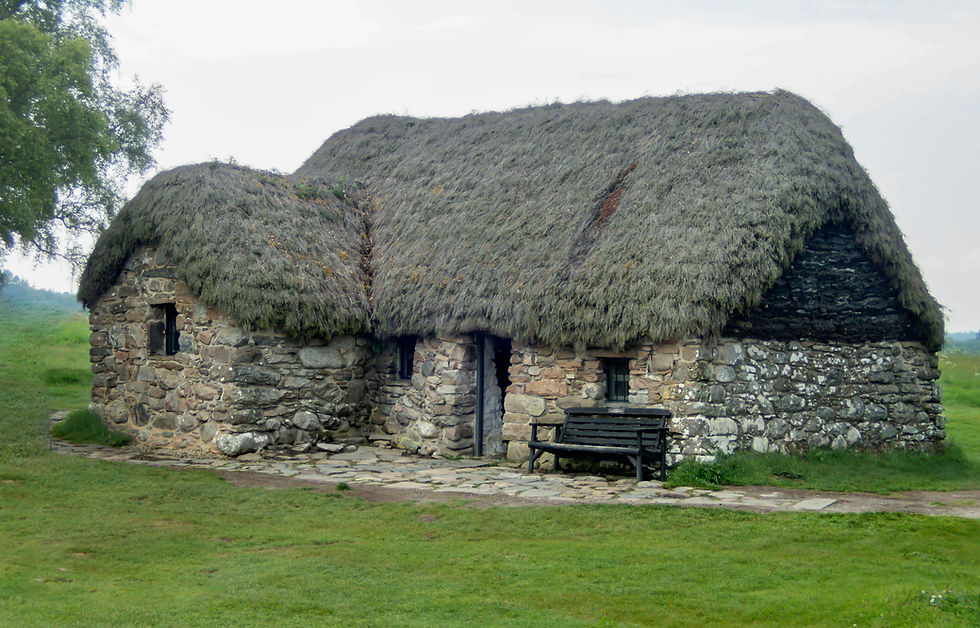
The point of contact where the battle was ultimately lost, is marked today by cairns erected some 140 years later. The losses on both sides are marked by the ingenious design of the wall on the Culloden Visitor Centre, and inside, the horror of 18th century warfare is laid bare in this unmissable museum.
What is more difficult to grasp is the aftermath of this tragic day. Jacobites through to the Victorian age would romanticise the Bonny Prince’s incredible 5 months on the run in the unforgiving highland wilderness, including his famous journey 'over the sea to Skye'. The Duke of Cumberland would never win another battle, and his legacy is not of this great success, but of death, destruction and cruelty. In Scotland he will always be the ‘Butcher of Culloden’ a name sealed with his fateful order that ‘no quarter’ was to be given to the dying or surrendered Jacobites.

3 days of murder around Inverness turned into years of destruction and persecution of a culture. How could the British empire expand with the threat of 300,000 Highlanders looming on its doorstep?
At last, the centuries of attempts by Scottish and British kings to destroy the Highland Clan system came to fruition under Gerorge II. The banning of everything from kilts to Gaelic itself led the Great British government under the Hanoverian monarchy into surely its darkest deed on this island: the ethnic cleansing of the Highland clans.
And so, the Highlands emptied; net emigration caused by the Highland Clearances exceeded birth rates, people were replaced by sheep farms, and the diaspora of the Highlands spread clansmen and women to the ends of the earth.
This is why the population of Scotland today, 5.4 million, is vastly exceeded by Scottish ancestry, with some estimates putting the number of Scots abroad as high as 20 million.
“Lean sinn thu, a Phrionnsa, chun a' chuain seo de reidhe is pheilear.”
Have you been inspired by this incredible story? Visit the infamous Culloden Battlefield and experience firsthand the haunting atmosphere of this remarkable place for yourself. Our Four Day Outlander Adventure tour includes Culloden as part of the journey, and we can also design a bespoke Jacobite-themed tour tailored to you. Just get in touch with us and we will be happy to discuss your plans and bring your journey to Scotland to life.


